27 May 2026
Beginner
This material is for beginner players

The concept of the effective stack size, or simply the effective stack, appears everywhere on poker forums and in training videos and articles.
It may sound like something complicated at first, but in reality, it is one of the simplest poker concepts you will ever learn.
The effective stack is the smaller stack between two players involved in a pot.
That’s all. No equations and no complicated theory.
When two players are involved in a hand, the effective stack between them is always equal to the smaller of the two stacks.
Examples of Effective Stacks
Ex. 1:
- Player A: $100
- Player B: $80
- Effective stack: $80
Ex. 2:
- Player A: $10
- Player B: $25
- Effective stack: $10
Ex. 3:
- Player A: $50
- Player B: $50
- Effective stack: $50
Effective Stacks in Multiway Pots
The effective stack is only defined between two players at a time.
For example, imagine four players with the following stacks:
- Player A: $100
- Player B: $80
- Player C: $125
- Player D: $50
In this situation, you cannot simply say that the effective stack is $50 just because that is the smallest stack at the table.
However, you can say:
- The effective stack between Player A and Player C: $100
- The effective stack between Player C and Player D: $50
If two players are in a pot, neither player can put more money into the pot than the smaller stack allows.
Let’s say you are playing $50NL. You have a full $50 stack, while all other players at the table have only $20 stacks. In this case, your effective stack against those players is also $20.
You cannot force them to put more than $20 into the pot, and they cannot force you to put in more than $20 either. Your extra $30 is basically useless in that specific matchup — or, in the context of this concept, ineffective.
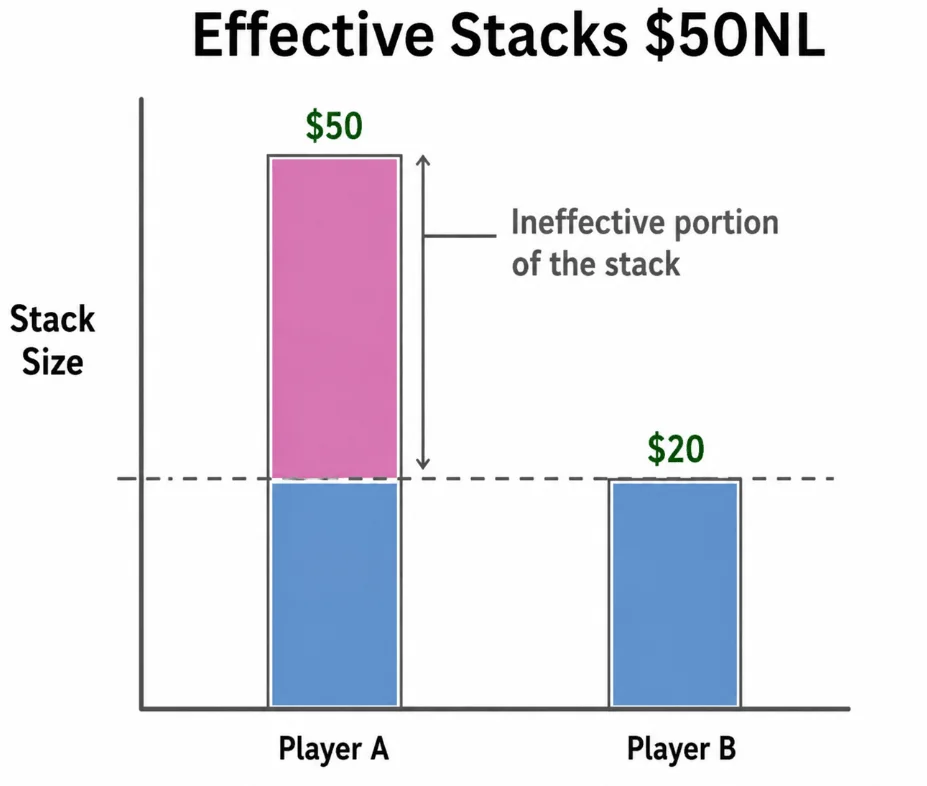
This is a simple diagram showing the effective and ineffective portions of a stack when playing against a shorter stack.
It is very important to understand this concept, because the fact that you are playing with an effective stack of $20 instead of $50 should dramatically affect your strategy and decision-making. If you do not yet understand why, I will explain it now.
- Note: The idea of effective stacks is somewhat similar to the principles of limit and pot-limit poker. In limit poker, the chance that players will get all their starting stacks into the middle during a single hand is so small that it is usually not worth worrying about.
Why Effective Stacks Matter
The fact that you are technically sitting with 100bb does not mean you are actually playing a 100bb-stack strategy against shorter stacks.
Against a short stack, only the effective portion of your stack matters.
That changes:
This is why experienced players always pay attention to effective stacks before making decisions.
Effective Stacks Considerations
You should always pay attention to the stack sizes of the players you are involved against.
If you are not used to thinking this way yet, you should start practicing it immediately.
Here are several important things to understand.
1. Implied Odds
If the effective stack is small, your implied odds become worse.
That means it becomes less profitable to chase draws or set mine against short stacks, because there simply is not enough money behind to justify the investment.
For example, if your opponent only has 20bb left, there is very little value in trying to hit a disguised flush or set, since even if you hit, you cannot win a large pot.
On the other hand, when effective stacks are deep, drawing hands become much stronger and more profitable.
2. Fold Equity
Bluffing becomes harder when effective stacks are short.
Small stacks create less pressure and therefore generate less fold equity. A short stack is simply not as intimidating as a deep stack.
Deep stacks allow you to apply much more pressure across multiple streets.
3. Stack-to-Pot Ratio (SPR)
SPR is another concept directly connected to effective stack size.
SPR describes the relationship between the pot size on the flop and the remaining effective stack.
This concept has a huge impact on postflop strategy and determines how committed players are likely to become with certain hands.
Short Stackers Notes
Short stackers — players who intentionally buy in short — fully take advantage of effective stack theory.
By playing shorter stacks, they reduce the maximum amount of money they can lose in a hand against each opponent.
Short stack strategy usually leads to simpler poker. These players rarely go far postflop before getting all the chips in.
As a result:
- They face fewer difficult decisions
- Their decisions become easier
- The game becomes more straightforward
This is one of the reasons many beginners prefer short stack strategies, and also why many strong full-stack players dislike playing against competent short stackers.
Sorry for the small tangent there, but it is actually a very good example of how effective stack concepts are applied and exploited in real games.
Final Thoughts on Effective Stacks
The effective stack is simply the smaller stack between two players. That’s it.
The concept itself is incredibly simple, but its strategic importance is massive.
Whenever you play a hand, always pay attention to effective stacks. They affect nearly every important decision you make in No-Limit Hold’em.