Imagine you have just learned how to add numbers. Now you’re ready to solve Einstein’s equations, right? No? Well, in poker, this happens all the time!
Dunning-Kruger Effect
The Dunning-Kruger effect, or "Know-It-All Syndrome" in poker is when a beginner, after winning a few hands, already sees themselves as Linus Loeliger.
Meanwhile, the real Linus still doubts if he is good enough for the WCOOP Main Event.
Signs of the "Know-It-All Syndrome"
- "I outplayed everyone!"
You won three hands in a row and are already planning to quit your job to become a poker pro? Congratulations, you have a severe case of the syndrome!
- "Poker is easy!"
If you think this after a week of playing, we’ve got bad news for you:
Poker is as simple as quantum physics for a cat.
- "Why should I study? I know everything!"
Ah, sweet ignorance! One day, you’ll realize you know about poker as much as a fish knows about bicycles.
- "Those pros are just lucky!"
Yes, of course. And Usain Bolt just happens to walk really fast.
Dunning-Kruger Effect Curve
Now, let’s break down the Dunning-Kruger Effect curve, or in other words, the stages of poker enlightenment.
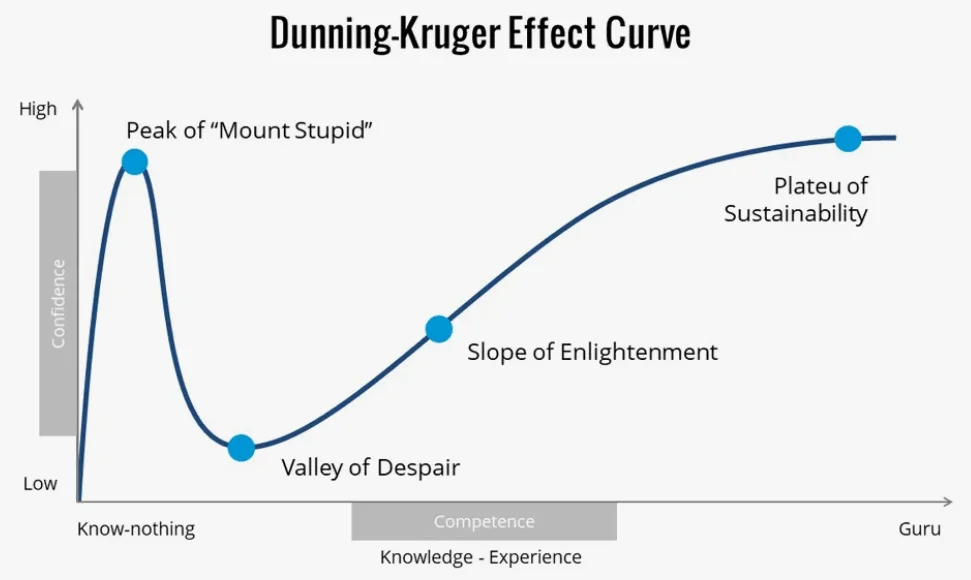
- Know-Nothing: You've just started playing poker and know nothing about it.
- Peak of "Mount Stupid": You’ve just learned to tell a flush from a straight and caught an upswing. The world of poker seems simple and clear. You’re sure you’ll be playing high stakes in a month. But then you lose your entire bankroll in one session and suddenly realize that poker might be a bit harder than you thought.
- Valley of Despair: You start studying and realize how much you don’t know. Poker seems like an unsolvable puzzle. You’re thinking about switching to checkers.
- Slope of Enlightenment: Gradually, you start understanding the depth of the game. Your poker skills improve, but so does your awareness of how much more there is to learn.
- Plateau of Sustainability: You’ve become a really good player. But now you understand that perfection has no limit, so you keep learning every day.
How to Overcome the "Know-It-All Syndrome"
- Accept your ignorance
The first step to wisdom is to admit you know nothing. Socrates said this, and he was a smart guy.
- Learn, learn, and learn some more!
Read books, watch poker videos, analyze hands. And no, watching the "High Stakes Poker" show doesn’t count as studying.
- Play against stronger opponents
Nothing grounds you more than a good beating from a better player. Think of it as a free poker lesson (well, almost free).
- Be critical of yourself
Analyze your game. Yes, even those hands where you played like a total noob. Especially those!
- Never stop improving
Even if you’ve become a strong player, remember: there’s always more to learn in poker.
In poker, as in life, the more you know, the more you realize how much you don’t know.
It’s not a reason to feel down, but an amazing opportunity to grow!
Who knows, maybe one day you’ll really become the next Linus. But until then, remember: overconfidence in poker costs a lot, and lessons in humility cost even more.

 Bluffaces