09 Apr 2026
Intermediate
This material is for medium-skilled players

Professional poker player and author David Sklansky introduced the so-called “gap concept” in his book Tournament Poker for Advanced Players.
The gap concept suggests that you should call with stronger hands than the ones your opponent uses to open raise.
The “gap” refers to the difference between the value range of the raiser and the value of the hands you are willing to call with.
This gap becomes larger against tight players and smaller against loose players.
It is also worth noting that this concept is not limited to Texas Hold’em. It can be applied to other poker formats with a betting round before the flop, such as Omaha or 7 Card Stud.
Gap Diagram
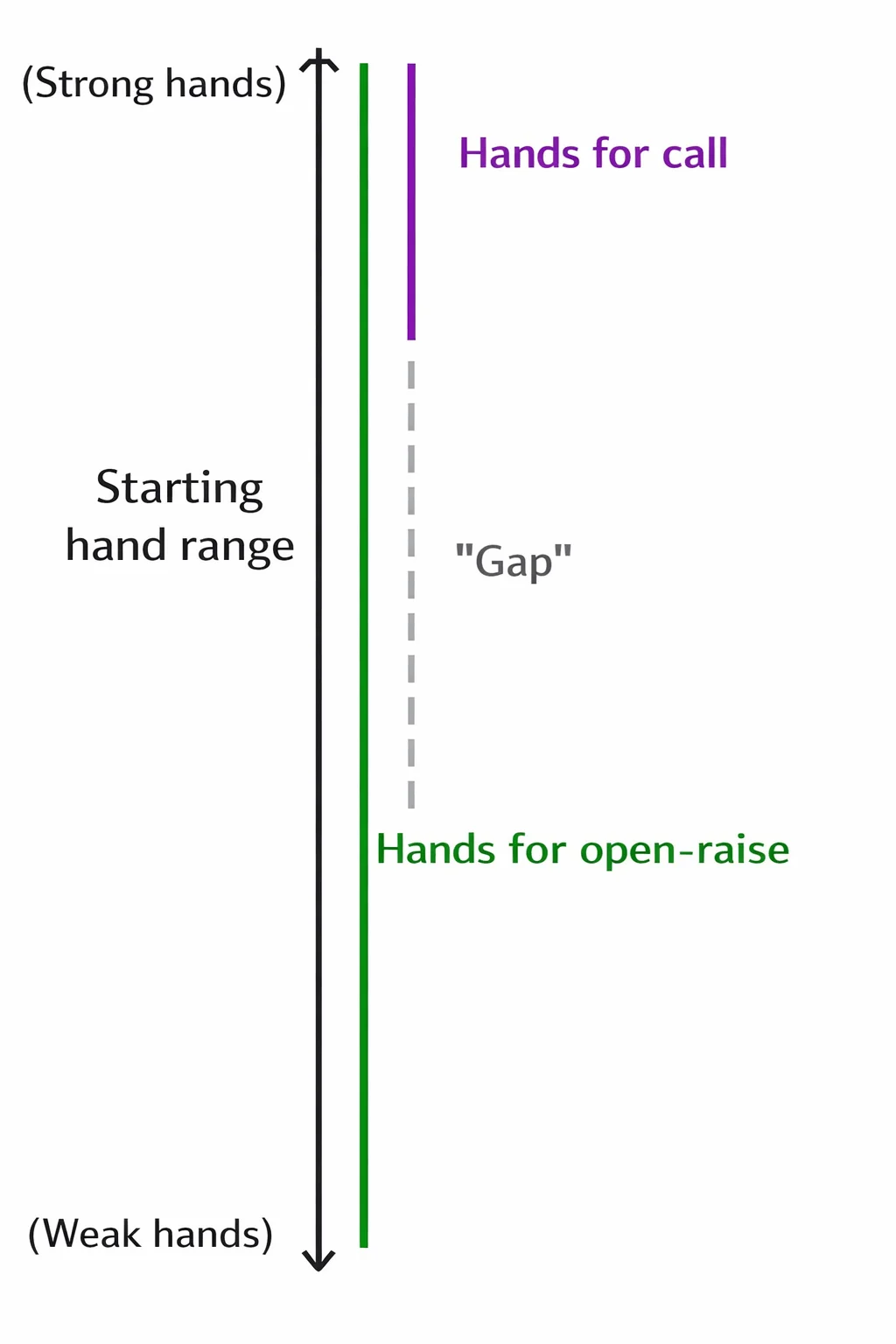
- For loose players with wide ranges, the green and purple lines extend;
- For tight players with narrower ranges, the green and purple lines shorten;
- The gap increases when a loose player bets into a tight player;
- The gap decreases when a tight player bets into a loose player.
Keep in mind that this is a simplified model. It does not account for important factors such as position, number of players, bet sizing, or table dynamics.
Gap Concept Example
Let’s look at a simple example.
You are in a MP or LP holding 
 . If there is a raise before you, especially from an early position, your opponent likely has a strong range.
An early position raise represents strength because the player must act before many others and will be out of position on later streets. Because of this, their range may include hands like AK, AQ, AJ, AA, KK, QQ, JJ.
Most of these hands dominate ATo, so folding is usually the correct decision.
An EP open raise represents more strength than a late position raise. However, if no one has raised before you, opening with ATo becomes a good play. Now you may have the best hand, and you can also take advantage of the gap concept yourself.
Other players will now need stronger hands to call your raise, because your action represents strength.
In addition, raising from a later position gives you a better chance to win the pot immediately, since there are fewer players left to act.
How the Gap Concept Works in Practice
The gap concept depends on how you estimate your opponent’s range.
The tighter your opponent is, the stronger their range will be. As a result, you need a stronger hand to call.
Against loose players, the gap is smaller, so you can call with weaker hands.
At first, this may seem complicated, but the main idea is simple:
- You need a strong hand to call a tight player’s raise
- You do not need as strong a hand to call a loose player’s raise
Conclusion
When you call a raise, your action usually represents strength to other players at the table. However, when someone raises, it does not always mean they have a strong hand. They may simply be playing aggressively.
The gap concept is mainly used to guide your calling decisions, not your raising decisions.
It also highlights the advantage of aggressive play and reminds you to be selective when choosing hands to continue against a raise.