MTT Preflop Charts — Poker Ranges for Tournaments
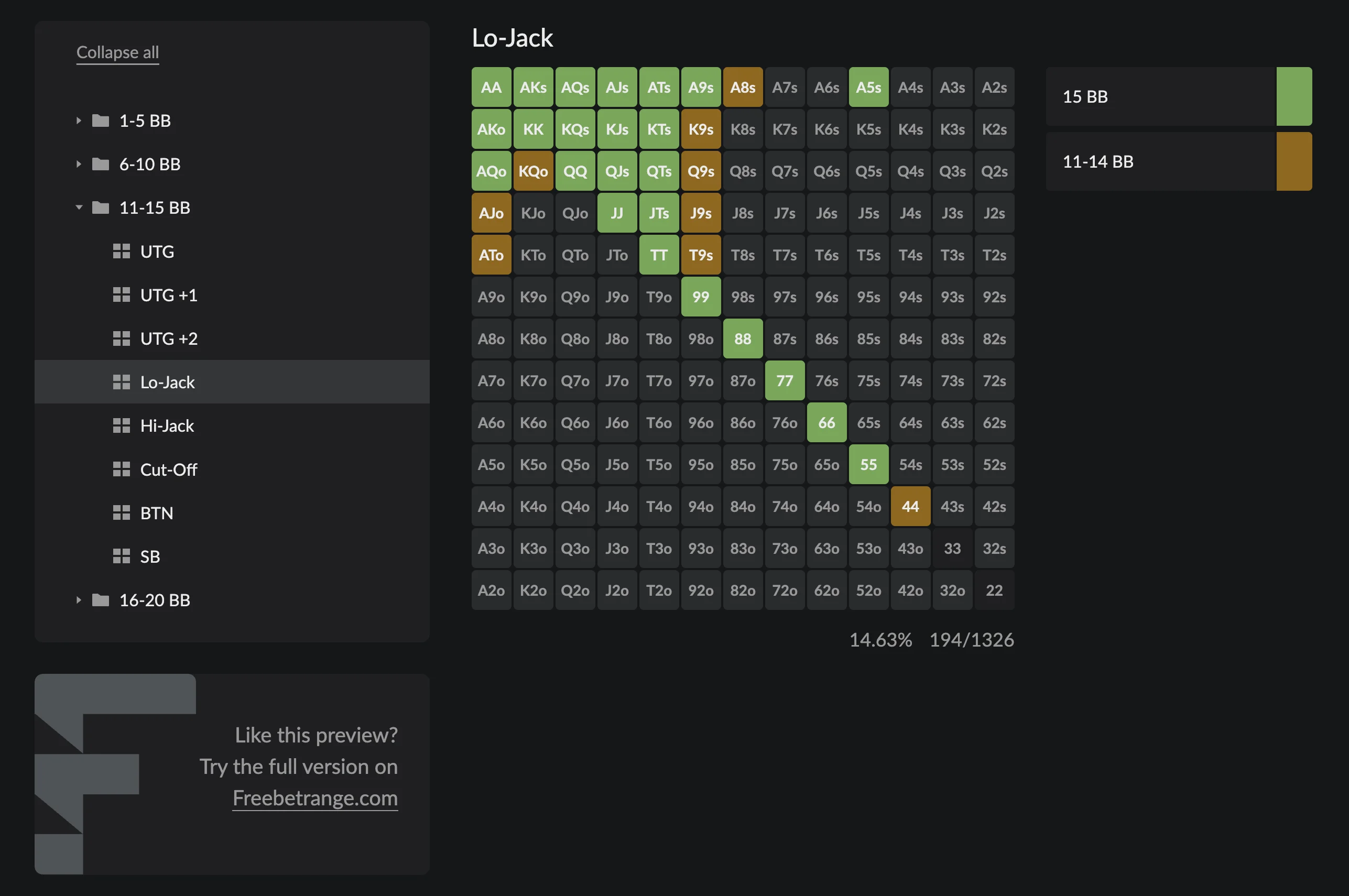
Explore MTT tournaments' preflop charts with optimal ranges by position and stack size. Charts help you to build winning tournament strategies.
 Use the chart library
 Create your own charts


 Dennis «Dennis_Stets»
 Jonathan Little
Tournament preflop strategy is fundamentally harder than cash preflop strategy — because the variables never stop changing. The blinds go up. Stacks get shorter. Antes appear. ICM pressure builds near the money. A range that's correct at 80BB becomes wrong at 30BB and outright disastrous at 10BB. Tournament players need not one chart but a stack-depth-indexed library — and that's what this section provides.
What's in this library
-
MTT Charts for 50–100BB Stacks by Jonathan Little — Deep-stack tournament ranges with antes. Covers opens, 3-bets, and 4-bet structure when stacks allow for postflop play.
- GTO Wizard MTT Open-Raise Charts: 60BB+ and >13BB — Solver-based open-raise ranges from one of the leading GTO software brands. Two stack ranges covered.
- ICM Push/Fold Charts at 9-Max No-Ante Tables — Endgame shoving and calling ranges with full ICM model, for the late stages where chip equity diverges from real equity.
How tournament preflop differs from cash
Three things separate MTT preflop from cash:
Antes change the math. Once antes kick in, the pot grows by 10–20% before action — making every open and every steal more profitable. Your opening ranges should widen by roughly 15–25% from late position.
Stack depth dictates strategy. At 80BB, you raise and play postflop. At 20BB, you shove or fold. At 12BB, almost every all-in is correct from late position. The right chart depends entirely on where you sit on the stack-depth curve.
ICM warps everything in the money. As you approach the bubble and final table, dollars stop equaling chips. Calling a shove that would be +EV in cash terms can be a clear fold in ICM terms. The ICM push/fold chart in this library is built specifically for that environment.
For mathematical drill-down on endgame play, try our ICM Calculator or study Poker Foundations by Jonathan Little, which works through every phase of tournament preflop in depth.
FAQ
What's the difference between MTT preflop and cash preflop ranges? MTT ranges shift dramatically with stack depth, antes, and ICM pressure. Cash ranges stay close to 100BB and ignore future-game considerations. A hand like K-J offsuit from middle position is a standard open in cash but a borderline fold in a 25BB MTT with no antes.
Should I use the same charts at the bubble as in early stages? No. Early-stage MTT play (deep stacks, no antes, no ICM) closely resembles cash. Late-stage play (short stacks, antes, ICM) requires the dedicated push/fold and ICM-adjusted charts in this library. Using the wrong chart at the wrong stage is one of the most common — and costly — tournament leaks.
When do antes kick in and how should I adjust? Most tournaments introduce antes around level 4–7. Once they do, the dead money in every pot rises meaningfully — and your opening, stealing, and resteal ranges should all widen. The MTT charts here that mention "with antes" already account for this; the no-ante charts are appropriate only for early levels.
What is ICM and why does it change push/fold ranges? ICM (Independent Chip Model) calculates the real-dollar value of your chip stack at each stage of a tournament. Because tournament payouts are heavily weighted toward the top spots, doubling your chips usually does NOT double your dollar equity. ICM-adjusted push/fold charts account for this: you call shoves with a tighter range than cash math would suggest, especially near the bubble or pay jumps.
How do these ranges change in heads-up MTT play? Heads-up changes everything. Open ranges from the small blind/button approach 80%+, defense ranges from the big blind get wide, and stack-depth effects are even more extreme. The Spin & Go charts in our Spin & Go section include heads-up coverage, which transfers reasonably well to MTT heads-up play.