Spin & Go Preflop Charts — Poker Ranges by Stack Size
Explore Spin & Go preflop charts with optimal poker ranges by stack size and position. Use ready-made charts or build your own Spin & Go strategies.
 Use the chart library
 Create your own charts

Spin & Go is the most preflop-dominated game format in poker. Three-handed play, a starting stack of just 25BB, hyper-turbo blind levels, and frequent all-in spots mean that 80%+ of your decisions happen before the flop. Get preflop right and you have a real edge; get it wrong and no amount of postflop play can rescue you.
These charts cover every phase of a Spin & Go — from the opening hand at 25BB to the final heads-up showdown at 5BB effective.
What's in this library
The Spin & Go charts cover three distinct phases:
Deep phase (25BB → 15BB). The opening levels, where there's room for raise-call play and postflop maneuvering. 3-max dynamics shift significantly compared to 6-max or full-ring cash — the button has more steal opportunities, the SB faces tougher squeeze threats, and the BB has to defend wider.
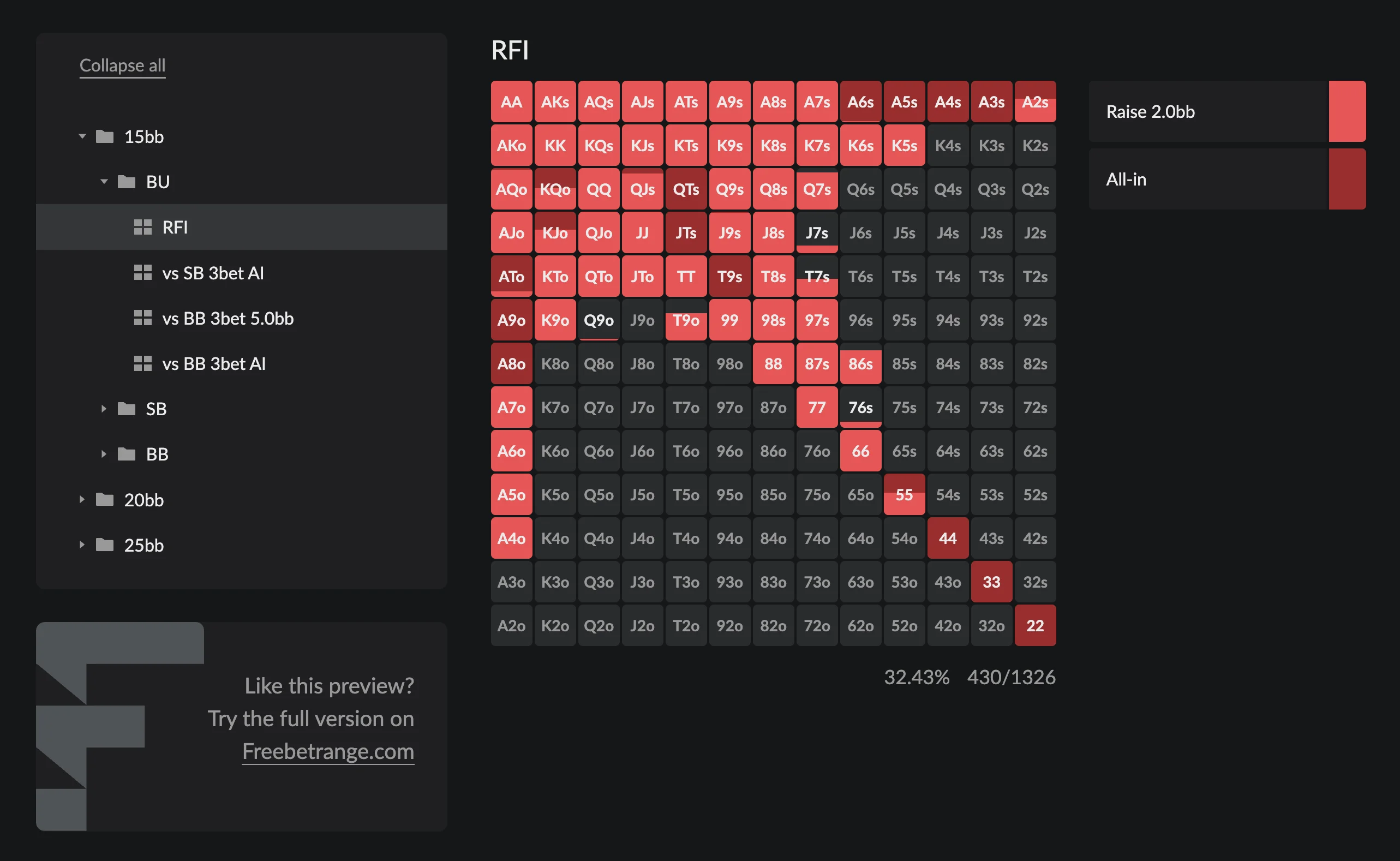
Mid phase (15BB → 10BB). The transition zone. Open-shoving from the BTN and SB becomes routine. Min-raises mix with shoves. Resteal pressure from the BB rises. This is where most edge is won or lost in Spin & Go.
Short-stack endgame (≤10BB). Push/fold territory. Almost every action is shove-or-fold, and heads-up play (when one player busts) requires its own dedicated ranges — wider opens, wider defense, more all-in confrontations.
Why Spin & Go is different
Spin & Go isn't just "MTT but faster." The 3-max format compresses every dynamic:
- Steal frequencies are higher than 6-max because there are fewer players left to act
- Stack-to-pot ratios drop fast — by level 4 you're already in shove-fold territory
- The big multiplier prize pool tilts ICM heavily; even a small fold equity advantage compounds
- Heads-up play is reached in nearly every game, so HU ranges matter as much as 3-max ranges
For a structured learning path, Spin & Go Poker Strategy by TeamBas walks through these dynamics in depth. You can also drill specific spots in our ICM Calculator and Push EV Calculator to see why these ranges work.
FAQ
Why are Spin & Go charts different from MTT charts? Spin & Go is played 3-handed with a starting stack of 25BB — versus 9-handed and ~200BB at the start of most MTTs. Three-max play means wider opening ranges, tighter calling ranges, and faster transitions into push/fold territory. MTT charts built for 50–100BB stacks don't transfer cleanly to Spin & Go.
At what stack depth should I switch to push/fold? The standard transition is around 10–12BB effective. Below 10BB, the math heavily favors all-in or fold over min-raising. Some spots (BB defense vs a small open, certain SB scenarios) still allow non-shove play down to ~7BB, but those exceptions are narrow and covered explicitly in the charts.
Do these charts assume rake and bounty/lottery structure? The push/fold and endgame charts assume standard Spin & Go ICM with the typical PokerStars/GGPoker prize distribution. Some adjustments may be needed if you play different operators with non-standard payouts, but the equilibrium framework is the same.
How do I use heads-up Spin & Go charts? Once a player busts, you're in HU play with whatever stack you've built. The heads-up ranges cover small-blind opens (very wide — 80%+), big-blind defense (wide, including 3-bet shoves), and ICM-adjusted short-stack play. Memorize these alongside your 3-max ranges — you'll reach HU in most games.
Can I use Spin & Go charts for MTT heads-up? Mostly yes — the HU sections transfer well to MTT heads-up play at similar stack depths. The main difference is ICM weighting: in an MTT final, pay jumps may be smaller relative to stack sizes than in a Spin & Go, so you can occasionally widen calling ranges marginally. Use Spin & Go HU ranges as a baseline and adjust based on the specific payout structure.
What's the fastest way to learn Spin & Go preflop? Drill the push/fold charts first — they cover the highest-frequency decisions (everything below 12BB). Once those are intuitive, layer in the 15–25BB ranges. Most Spin & Go students see meaningful winrate improvement within 2–3 weeks of focused chart study, because so much of the game lives in preflop spots.