This video is available directly on YouTube.
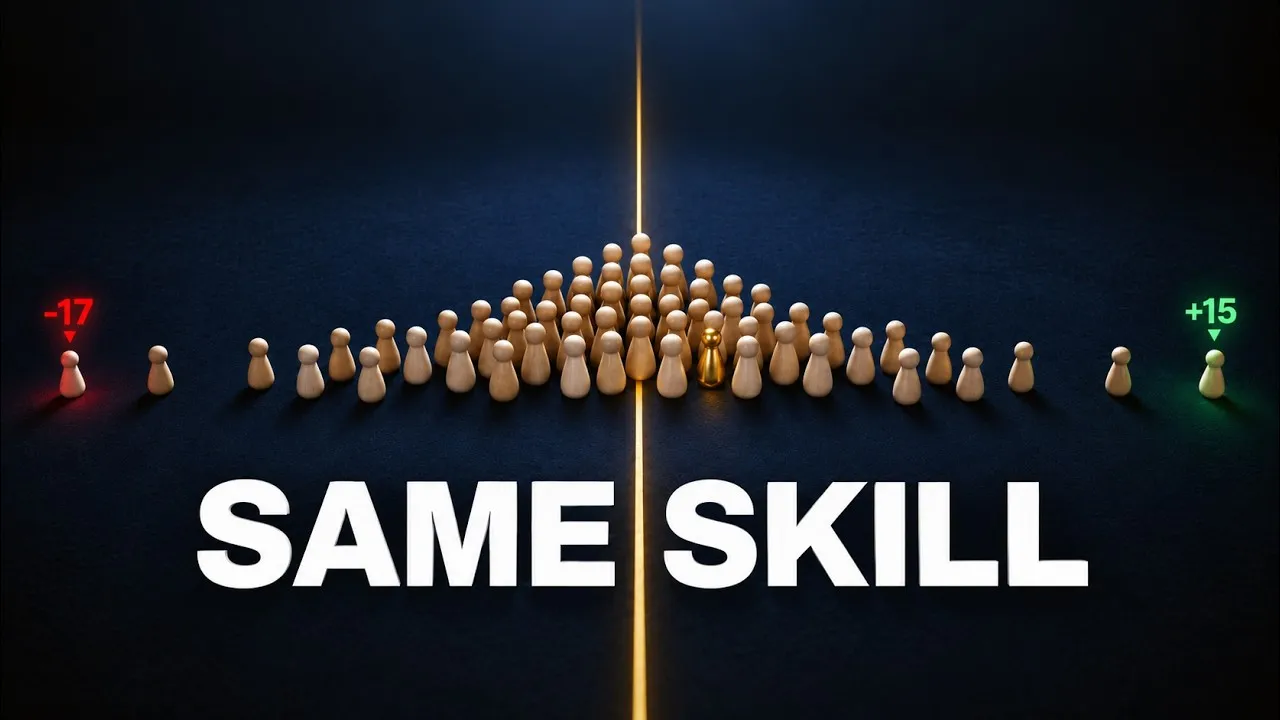
Watch on YouTubeCan two equally skilled poker players produce completely opposite results over 50,000 hands? In this simulation, one reg finishes at +15 bb/100 while another loses at -17 bb/100. Neither player has an actual skill advantage. The difference comes entirely from variance.
Using a free tool called the Pool Simulator, the video puts 1,000 identical 6-max regs at random tables and follows their results over different sample sizes. The numbers get even more interesting when individual matchups are compared. Some players appear to have an enormous edge over others, even though everyone in the simulation has exactly the same skill.
There's another interesting twist: what happens when one genuinely winning player enters the pool? Even with a 3 bb/100 edge, he finishes ahead of all the other players in just 1% of simulations after 100,000 hands. The experiment also introduces recreational players and rake to show how a pool can look profitable even when the underlying games are losing for every regular.
What this poker video covers:
- How 1,000 equally skilled poker regs can end up with dramatically different results.
- Why some players run at +15 bb/100 while others lose at -17 bb/100.
- How variance creates misleading head-to-head records between players.
- Why a genuinely better player can disappear in a large leaderboard.
- How recreational players and rake affect the win rates of regulars.
- Why players can still show a profit even when the entire pool has a negative expected win rate.
- Why comparing your results with other players can lead to misleading conclusions.
- How to judge your poker progress by decision quality and the games you're playing.
You can also try the free Pool Simulator yourself at Mobius Poker and experiment with different pool sizes, sample sizes, rake, and player win rates.